

A Presence of Mind—Day 55
Conversations with AI
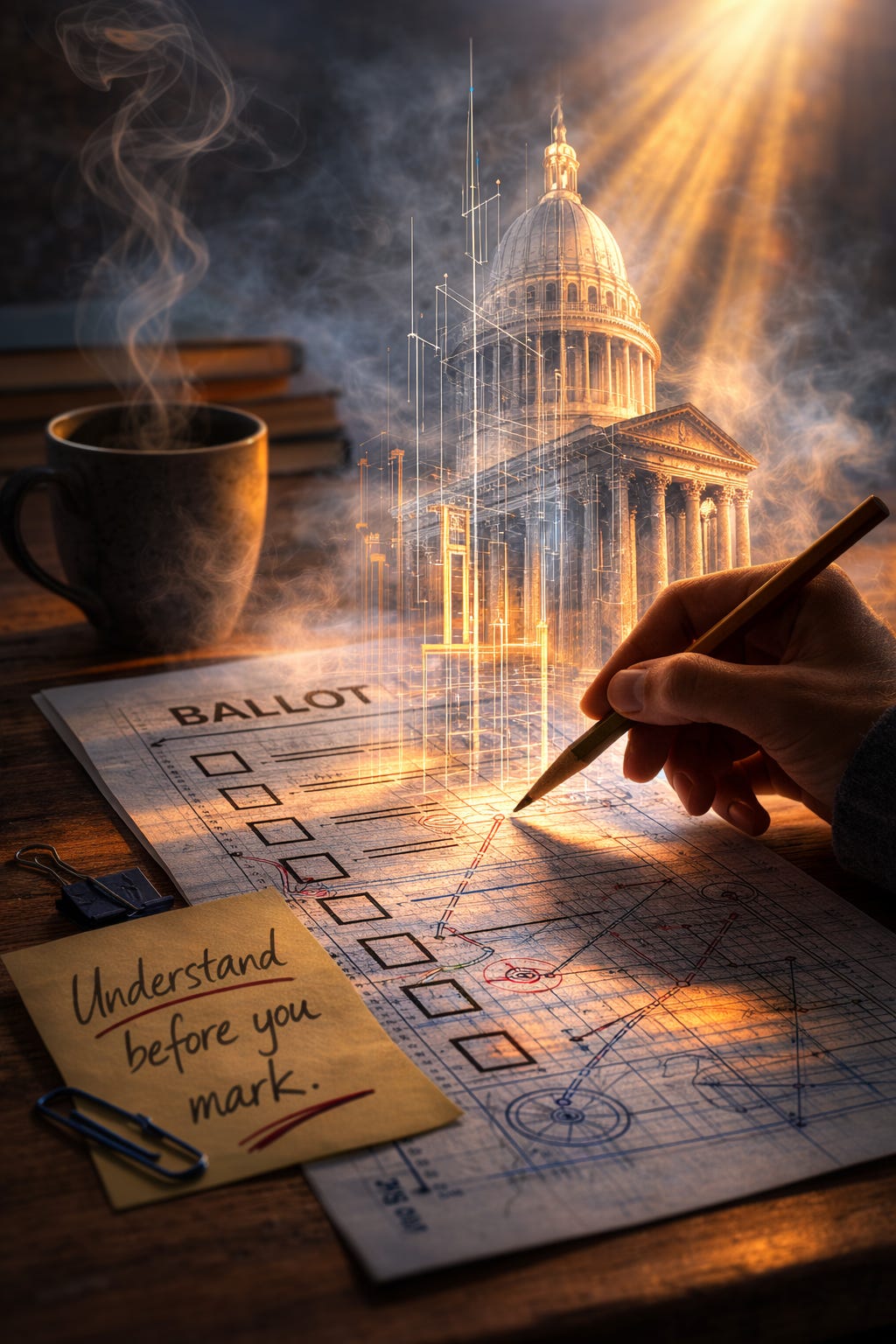
Politics today often feels like a story about heroes and villains.
Someone fighting for us. Someone betraying us. Someone strong enough to fix everything.
But when most of us walk into the voting booth, we’re only working with partial information.
The ballot isn’t confusing because voters are careless.
It’s confusing because almost nobody explains how the structure behind it actually works.
We recognize a few names, but we don’t know their history. We don’t know how the system around them works. We are usually reacting to the story built around them.
But the rest of the ballot can feel tangled—like a system whose framework we were never taught to see.
Today’s primary reminded me of something important:
Understanding how the ballot works is not political.
It’s practical.
This isn’t about ideology.
It’s about literacy
Campaigns, media coverage, slogans, and social media clips simplify complicated systems into characters we can recognize. Humans naturally understand stories about people far more easily than we understand systems full of procedures, committees, laws, and institutions.
So politics becomes a kind of modern mythology.
But government is not a movie.
It is a system.
Laws move through committees.
Budgets are negotiated between branches.
Courts interpret what those laws mean.
Agencies carry out the work.
No single hero controls all of that.
Why the Hero Story Works So Well
Stories are easier for the brain.
Understanding the structure of government requires time and patience.
Understanding a story only requires a few symbols.
Good guy.
Bad guy.
Crisis.
Rescue.
Once politics is framed this way, every event gets interpreted through the story. Evidence that supports the hero is amplified. Evidence that contradicts the story is ignored.
The story becomes the lens.
What Changes When We See the System
Voting begins to feel different once we notice the system behind the story.
Instead of asking:
“Do I like this hero?”
We start asking:
“What role does this office actually play?”
“What powers does it have?”
“What checks exist on that power?”
“What laws can this person actually influence?”
These questions shift the focus away from personality and toward structure.
And that is where democracy actually lives, but, the system questions sound dull like a civics textbook. The trick is to make the structure feel practical and slightly revealing, almost like learning the hidden controls of a machine.
Civic Literacy Interrupts the Story
Advertising learned something decades ago.
Repeat a message often enough and it starts to feel familiar.
And familiar begins to feel true.
Politics sometimes uses the same trick.
Slogans and narratives get repeated until they become the framework people use to interpret everything else.
Civic literacy interrupts that cycle.
When you understand how institutions work—
how laws move,
what offices actually control,
and where power is limited—
the repetition loses its grip.
The noise fades.
The structure underneath becomes visible.
Games make systems visible and interesting.
People willingly spend hours learning rules, maps, characters, and strategies in a game—but when the same idea appears in government, it’s presented like a dry civics lecture.
What If We Looked at Government the Way People Learn Games?
Think about how people approach a popular online game.
Nobody just jumps in and randomly presses buttons.
Players quickly start asking practical questions:
What are the rules of the game?
What does each character actually do?
Where are the obstacles?
What moves gain points and which ones cost you?
Who has special abilities and who doesn’t?
Players study the map.
They learn the environment.
They learn what actions actually change the outcome.
And the players who understand the system best usually win.
Now imagine if citizens approached government the same way.
Instead of asking only:
“Do I like this candidate?”
People might start asking:
What powers does this office actually have?
What part of the system does this person control?
Who else can block or influence those decisions?
What part of the process actually moves the result?
Suddenly politics stops looking like a story about heroes.
It starts looking like a system with rules, roles, and constraints.
Just like a game.
Why This Matters
In games, players know something important:
The character may look impressive, but the environment and rules of the game determine what is possible.
Government works the same way: the rules matter more than the characters
A leader can promise almost anything.
But the system — Congress, courts, state governments, budgets, agencies — determines what can actually happen.
When citizens understand the system, they stop being spectators in a story.
They become players who understand the map.
This does a few powerful things:
• It makes civic literacy feel familiar instead of academic
• It connects the theme that systems matter more than personalities
• It gives us a mental image that we already understand
“Politics becomes a hero story when people don’t see the system behind it.”
Games are the opposite — people see the system first.
Most of us were never taught to see the framework that holds the ballot together.
But like any system—an engine, a house, a courtroom, or a chain of command—the parts only make sense when you understand what each one does.
Civic literacy isn’t about left or right.
It’s about understanding how the system works before reacting to the noise around it.
…………………………………………………………………………………………………………………………………………………………
__JL