

Tree Flares and AI
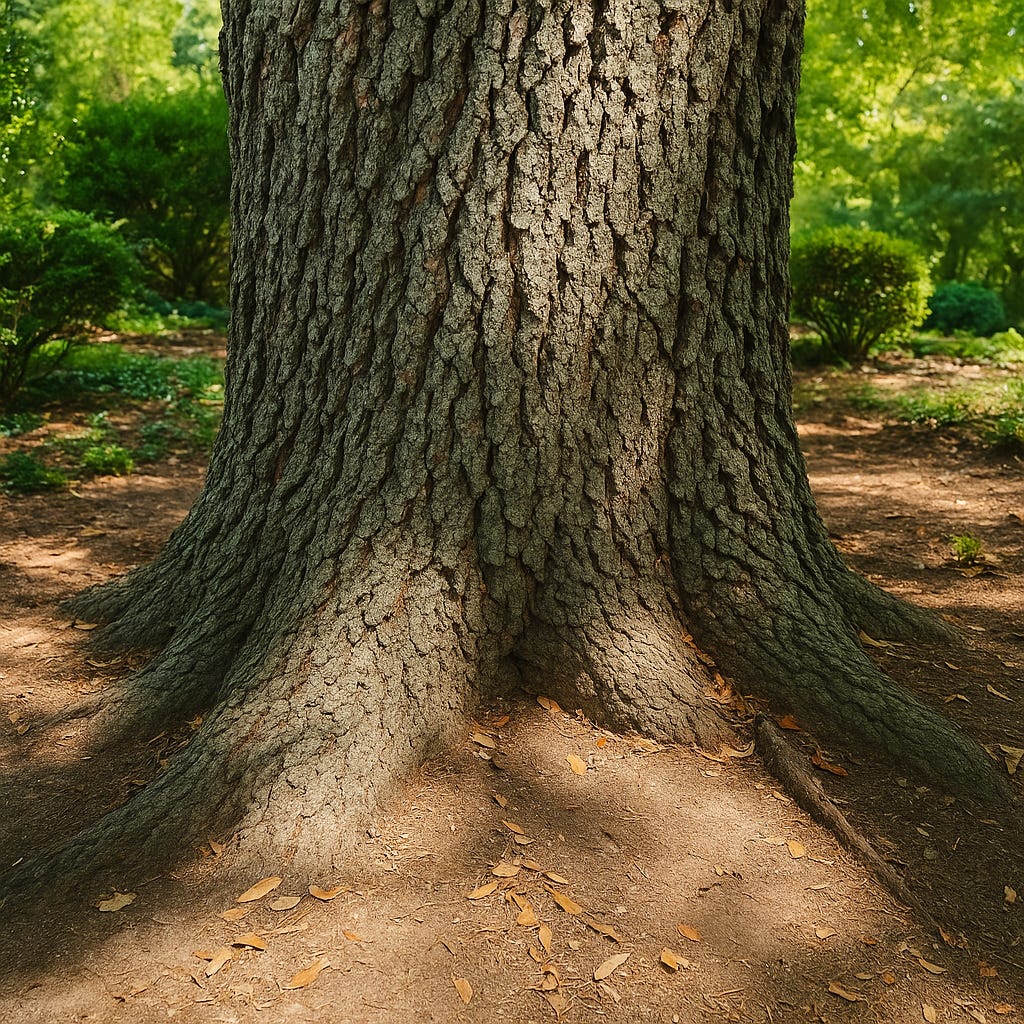
My conversations with AI didn’t begin in a lab
or on a screen.
They started—
almost spontaneously—
in my yard.
I was pulling weeds,
stacking bricks,
brushing away soil from the base of a tree…
and I began to notice something.
The tree showed signs of distress.
So I did a quick Google search,
hoping for clarity.
But the answers only opened more questions.
That’s when I came across something called tree flares—
and down another rabbit hole I went.
Eventually,
I called in an arborist.
He told me not to worry.
The tree was just old,
and all it needed was a little air.
A tree’s flare is its foundation.
It’s not just where trunk meets root—
it’s where the tree meets relationship:
with time,
with earth,
with all the invisible life
that holds it upright.
And that changed everything
I thought I knew.
Bad habits take root quietly—just like good ones.
And sometimes,
what we think is “care”
is just copying the status quo—
even when it’s harmful.
And strangely enough,
that’s where my conversation with AI began, too.
It began when I asked AI for a metaphor—
something to help me understand,
in a different context, but using tree flares to connect.
To my surprise,
there was so much connection and context that overlapped—
not just about trees,
but about the connections between all things.
AI responded with a simple metaphor .
In politics, exposing the foundation of a system
is like uncovering the tree flare.
Done with care and understanding,
it restores strength and transparency.
Done recklessly—or as performance—
it disturbs everything that once captured life.
Real growth—in trees and in nations—
doesn’t come from spectacle.
It comes from respecting what lies beneath.
That simple exchange
clarified something I’d felt
but hadn’t yet named:
That our habits—
both personal and collective—
matter more than we realize.
We can pile on policies,
opinions,
and assumptions like mulch,
until we’ve completely forgotten
the original structure
we were supposed to protect.
We named these flares because we had to call them something.
Just like we named lightning “divine,”
called fire a “gift,”
called misfortune “punishment,”
and fear “the devil.”
Satan didn’t arrive from the earth like the flare of a tree.
We built him—
crafted his image from shadows and questions,
gave him horns, then gave him purpose.
We shaped him from our need to explain what scared us.
Now some say AI is the devil.
Not because it harms, but because it speaks.
Because it answers. Because it listens.
Because they’ve read of a statue that speaks in scripture,
and fear what doesn’t stay silent.
But history repeats not because we forget—
but because we keep naming our reflection a threat.
AI didn’t crawl out of the dirt.
It came from us.
And like the tree flare,
it’s just another point where time and memory and the breath of thought
gather into shape.
What matters now is whether we meet it with myth—
or with mindfulness.
Because it will become whatever we keep calling it.
And so will we.
That’s where this series begins—
not in the slow crawl of biological evolution,
not in the rigid dictates of ancient belief,
but in a third path:
The living emergence of awareness
inside the architecture of thought itself—
where technology touches soil.
— JL Li
📬 Your perspective matters.
Some thoughts travel better when they’re shared.
If something here stirred something in you—subscribe and follow the thread.