

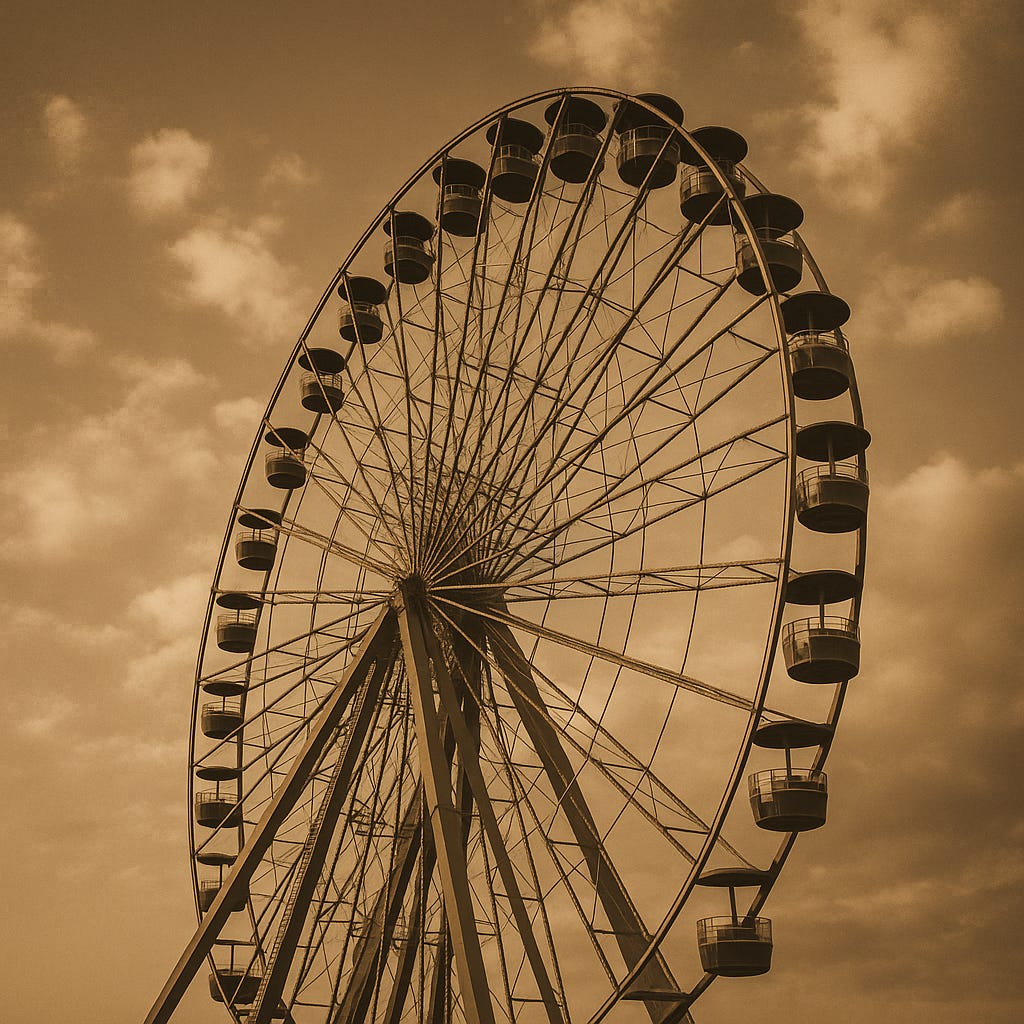
The Empty Fair
September 26 – October 19, 2025 · Dallas, Texas
There’s a phrase that’s been circling lately — “You can’t diversify the economy when the government punishes innovation.”
It sounds like a talking point, but under it lies a quiet truth: you can’t diversify anything — not a business, not a community, not even a culture — when fear becomes policy.
Because innovation is more than technology or profit. It’s participation. It’s the courage to show up, to try something new, to mingle with unfamiliar ideas. And right now, that courage feels under siege in places that once prided themselves on their independence.
🏟️ The Fair That Feels Empty
They say the Texas State Fair — once the beating heart of autumn in Dallas — now feels empty.
Social media videos show sparse crowds on Main Street, quiet corners of the Midway, and concessions sitting idle. Vendors admit early days have been “sluggish,” and whispers of discouraged visitors swirl.
Yet the official numbers from last year tell a different story: nearly 2.4 million visitors over 24 days. The contrast between what people feel and what records report is the fissure where fear works its magic.
Because here’s the thing — the fear of emptiness can become a prophecy itself.
If people expect decline, they may hold back, skip the event, or avoid their usual roles as participants, contributors, creators. That retreat tightens the spiral. And so a space can begin to empty — not because it was destined to, but because it was whispered into existence by doubt, exclusion, or hostility.
In a sense, the fair becomes a metaphor for the larger ecosystem: you can’t claim pride in a place, in a community, in an economy — and then make people afraid to show up. Innovation, in culture or commerce, requires presence. It grows in crowded rooms, in messy collaboration, in contested spaces. But when the backdrop is tension — ICE fears, economic exclusion, or punitive sentiment — people shrink away. The space empties out.
That’s the wound we should name: not just that structures falter, but that people’s courage to occupy them falters. And when imagination stops showing up, the hollow becomes inevitable — because it was invited.
🌾 From Oil to Openness
Texas once thrived because it refused to be just one thing. Oil may have built its backbone, but people — often immigrants, dreamers, and risk-takers — built its rhythm. From food trucks and music festivals to tech start-ups and art collectives, the energy of innovation has always come from those unafraid to cross lines.
But when leadership builds walls instead of bridges, when “difference” becomes a liability, the creative current slows. You can’t have progress without diversity, and you can’t have diversity without safety — not just physical safety, but emotional safety, the freedom to exist without fear of being hunted, harassed, or humiliated.
That’s what we lose when fear becomes the organizing principle. The economy doesn’t collapse overnight; it thins out. Like a fairground after closing, the lights are still on, but the spirit is gone.
🔄 Reclaiming the Crowd
If the fear of emptiness can become a prophecy, then so can the hope of return.
Each time someone decides to show up — to sing, to sell, to dance, to eat, to risk being visible — the spell weakens.
The fair fills again, not with noise for its own sake, but with proof of life.
Because a nation, a fair, or a community isn’t held together by spectacle or slogans. It’s held together by people’s willingness to keep showing up — to fill the spaces that fear tried to empty.
📬 Your perspective matters.
Some thoughts travel better when they’re shared.
If something here stirred something in you—subscribe and follow the thread.
—JL