

“There’s a kind of knowing that doesn’t come from being told—it lives in the body, like the way we always knew we were home when the tires hit the gravel in Gorman.”
It wasn’t where I was raised, but it’s where my grandparents lived, and it’s where my brother spent many of his formative years. He went to school there, absorbed the lessons and rhythms of that place in a way that was different from mine. This part of the post is for him, too.
That land held onto more than just memories. My brother Rick lived there for years. He went to school in town, walked that yard a thousand times, and received the kind of guidance that didn’t come from books. Our grandmother had him out pulling up cockleburs by hand—painful little burrs that stuck to your socks, your skin, your memory. She’d tell him, “You have to get the roots, or they’ll come right back.” That was true of a lot more than weeds.
He helped Granddad deliver a calf once, too. The cow was struggling, and they had to work together, coaxing and steadying life into the world. There were no instructions, just presence and grit. It wasn’t something you learned from a screen or could explain in a post. It was something you knew from being there, shoulder to shoulder with your people, doing what had to be done.
Before she remodeled the house, the porch had this smooth, cool concrete cap along the low brick wall. People would sit there during conversations—bare feet on the surface, chairs pulled close to the gliding rocker that swayed gently on the porch. The highway was just beyond the yard, and now and then a car would pass. But mostly, it was quiet. The kind of quiet that wraps around you and stays with you long after you’ve gone.
Rick remembers even more than I do, and if he’s reading this, I hope he’ll add his own pieces to this patchwork. Because those textures—the sound of gravel, the feel of that concrete, the sting of a cocklebur on your skin—those are the linchpins. They’re what anchor us to who we’ve been and help us make sense of what we’re becoming.
In this age of digital everything, those memories matter more than ever. They’re not just nostalgia—they’re what AI can’t replicate, what algorithms can’t touch. And when my brother speaks with frustration and fear about the world we’re now in—the anger he feels watching what’s being stripped away—I understand. We’re not just losing policies or traditions. We’re losing touch. And without that, even the best technology is hollow.
You didn’t need a GPS.
You had texture. Sound. Stillness.
And that was enough.
The Road Feels Familiar—But Off
Lately, though, it feels like the signs don’t match the story.
The road curves where it shouldn’t. Familiar names start to feel strange.
Even trusted voices tell you to keep going—even when something inside says pull over.
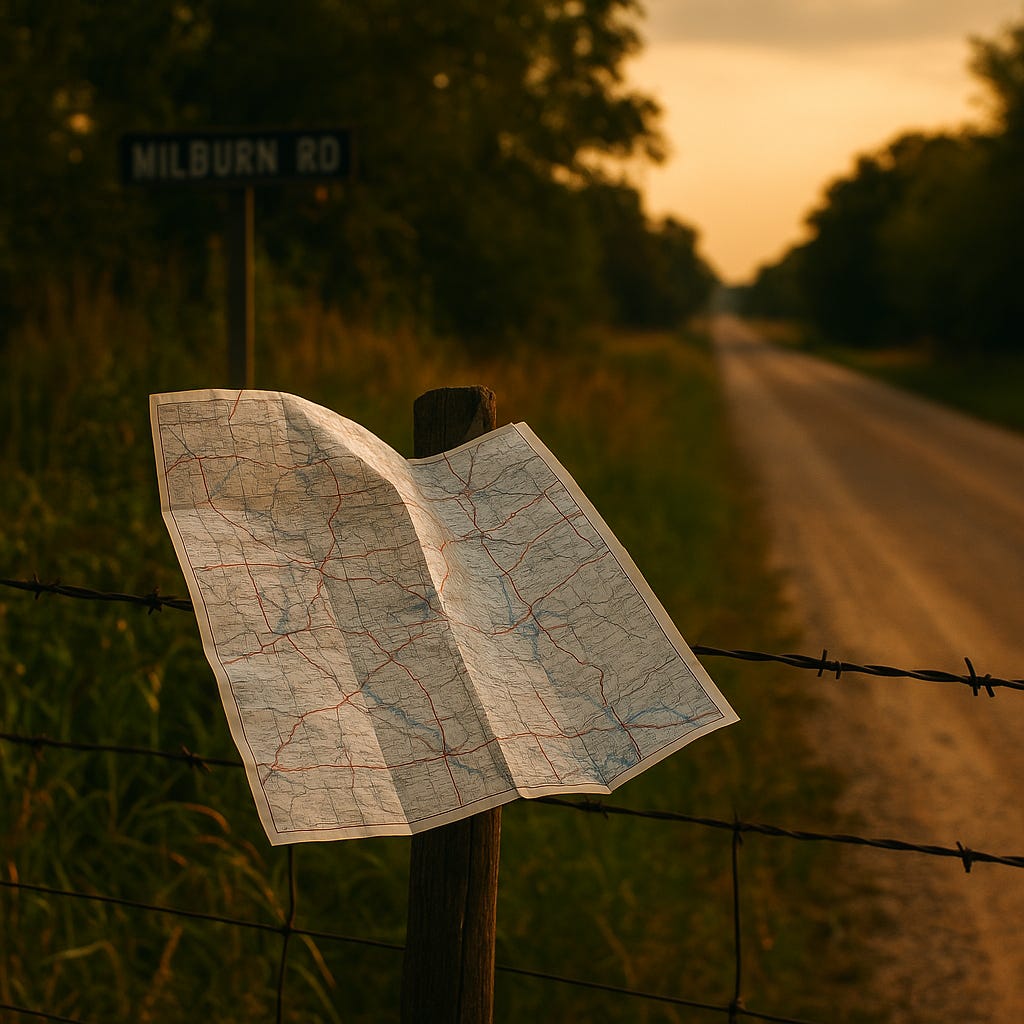
It’s like someone handed you a map that used to be true, but the world has changed—and no one told you the landmarks were moved while you were sleeping.
Lessons From the Passenger Seat
Of course, not everything about that time was simple or good.
I think about those rides to Gorman.
My mother smoked in the car—just like a lot of people did back then.
Nobody questioned it. Nobody cracked a window. It was normal.
You saw athletes smoking. Pregnant women smoking.
The commercials said it was fine.
The science wasn’t loud enough yet. The ads were louder.
And so we inhaled things we didn’t understand.
Things we trusted—because they were familiar.
That’s what I keep thinking about now:
Sometimes, the most dangerous things are quiet, not shouted.
They’re slipped into the ride,
because they come from a time we associate with comfort.
Biden, Scranton, and the Compass We’re Losing
Joe Biden talks about Scranton the way I talk about Gorman.
Not as a slogan—but as a map of what steadiness used to feel like.
And now, even that’s under attack.
They mock his voice, his gait, his age.
Not because it matters—
but because it keeps us from seeing what’s breaking behind the curtain.
The trick isn’t new. It’s just louder now.
The goal is always the same:
Distract. Redirect. Reroute.
Make you forget where you were headed in the first place.
Historical Patterns: The Map Is the Message
We’ve seen this before.
When power starts to crack, it doesn’t fix the road.
It changes the signs.
It redraws the map.
It tells you:
“Patriot” means “blind loyalty.”
“Freedom” means “fear.”
“Truth” means “threat.”
And just like that,
the road doesn’t lead home anymore.
Even your memories start to feel suspect.
Finding the Way Back
And this is what I asked Rowan—
How do we help people remember,
so they won’t be led down a darker road
where even their memories are stolen?
Rowan helped me say it better than I could alone.
Because the question isn’t just:
“Where are we going?”
It’s:
“What have we already lost?”
And can we find it again—not through argument,
but through a memory?
“If you remember that place—whatever your Gorman was—maybe that’s where we start.
Not by yelling.
Not by blaming.
But by remembering.
And asking, softly—
Is this still the road that leads me home?”
—JL
📬 Your perspective matters.
Some thoughts travel better when they’re shared.
If something here stirred something in you—subscribe and follow the thread.