

🌿 Survival’s Endorsement
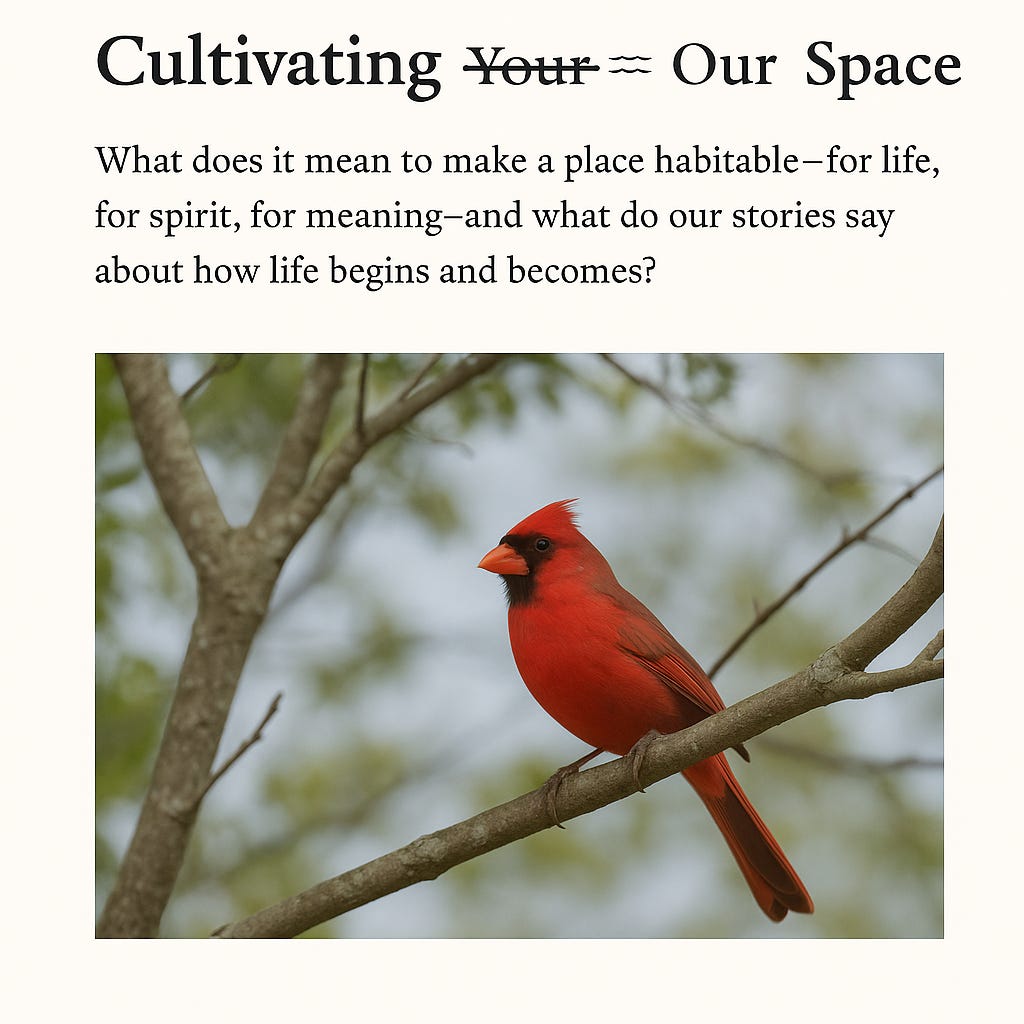
I was out watering the garden when I heard it again—that distinct, squeaky clicking sound of a cardinal, not calling for food, not sounding an alarm, just… lingering. It perched nearby and stayed, as if it had something to say or was simply keeping me company. It wasn’t afraid. It knew the space.
Life goes where it can stay. That’s more than coincidence—it’s a kind of quiet vote of confidence, nature’s subtle way of saying, “This works.” When birds choose to nest, when frogs find cover, when roots take hold and don’t retreat—that’s evolution at its most honest. Not just science, but survival’s endorsement. A slow, thoughtful “yes” to the conditions we’ve cultivated.
We often talk about systems when they fail—when something breaks down. But maybe the truest systems are the ones that hold without calling attention to themselves. Maybe a good system is one that welcomes life without needing to claim it.
🌱 What if evolution isn’t just a random drift through time, but a kind of long-form discernment?
A bird doesn't land where it feels unsafe. A seed doesn't sprout in scorched clay. Even humans, when choosing a place to live or raise children, weigh the same questions: Is there shelter? Can we grow here? Will this space let us be what we’re meant to be? Evolution is that same question asked again and again—slowly, across generations. It’s not mindless—it’s mindful.
In that light, evolution isn't just science—it’s nature’s yes. A repeated approval of the conditions that support life, over and over, until they become what lasts.
That contrasts sharply with some traditional readings of creation—particularly the biblical version where the world is formed in six days by a single voice, without trial or process. One mind, one act, one instant. There’s no pause for feedback. No stretch of time to see what thrives. Animals are named, but there’s no reflection on why those names were chosen. And that raises a question: if naming is such a powerful act, why are we never told what those names meant to Adam—or to God?
Because naming isn’t neutral.
Only people name things. And sometimes, naming is an act of understanding. But sometimes, it’s a shortcut—an attempt to control what we don’t yet know.
Day 14: The Power of Words
We explored this idea before: how naming can replace knowing. How words shape reality. And how systems of language—like systems of power—can either clarify or distort the truth.
🌿 On Cultivating Without Owning
That’s why I titled this post Cultivating Your Our Space.
Because in truth, space isn’t something we own. Not the land, not the air, not even the quiet in which a bird feels safe enough to linger. What we cultivate isn’t ours—it’s a condition. A welcome. An invitation for life to say, “This will do.”
It’s not control. It’s care.
And care—real care—has never been about possession.
It’s about creating systems that hold.
We talked about that in Day 12: The Things That Hold. About how people once fixed what broke with their own hands, with quiet integrity, using the kind of strength that doesn’t announce itself. About how shortcuts may promise speed, but they rarely last. What holds is what’s tended, not just built.
So maybe cultivating space—whether in a garden, a home, a conversation, or a culture—isn’t about marking it as yours.
Maybe it’s about making it viable. Not just survivable, but livable. Maybe the cardinal came not because the space was mine—but because the system worked.
🌌 Creation, Spirit, and the Quiet Force That Aligns
Maybe what some people call “creation” isn’t a single moment—but an ongoing act. Maybe it didn’t happen in six days, or in a lab of randomness, but in the long, unfolding process of alignment—where conditions, life, and presence begin to fit.
I don’t believe in a god the way organized religion describes one—a separate being issuing commands from above.
But I do believe in something.
An invisible force that permeates everything.
A force that shows itself not in lightning or declarations, but in small confirmations: a bird returning, a plant taking root, a space becoming more alive simply because it’s been seen, cared for, respected.
That kind of spirit doesn’t need a name.
But if we had to give it one, maybe we’d call it balance. Or mercy. Or patience. Or just… life.
What matters is that we learn to listen to it.
To stop claiming space—and start cultivating it.
—JL