

The original question I was wrestling with came from something Leonard Shlain wrote in The Alphabet Versus the Goddess—that over time, whoever controls the flow of information gains mastery over every other class, including the warrior class. In ancient societies, physical dominance—brute strength—was the primary source of power. But eventually, that dominance was usurped by those who controlled language—whether through sacred texts, written laws, or priestly interpretation.
Now, I believe we’re seeing this same pattern repeat—but with a twist.
The people who believe they are still the warriors—the defenders of freedom, masculinity, and tradition—don't realize that they are being controlled by language. Not sacred scripture, but by carefully repeated slogans. They are being manipulated through repetition. These words are not neutral; they are chosen. Repeated. Programmed. And then echoed back through them.
They carry shields, but the real weapon is now the word—and they don’t even realize it’s being used on them.
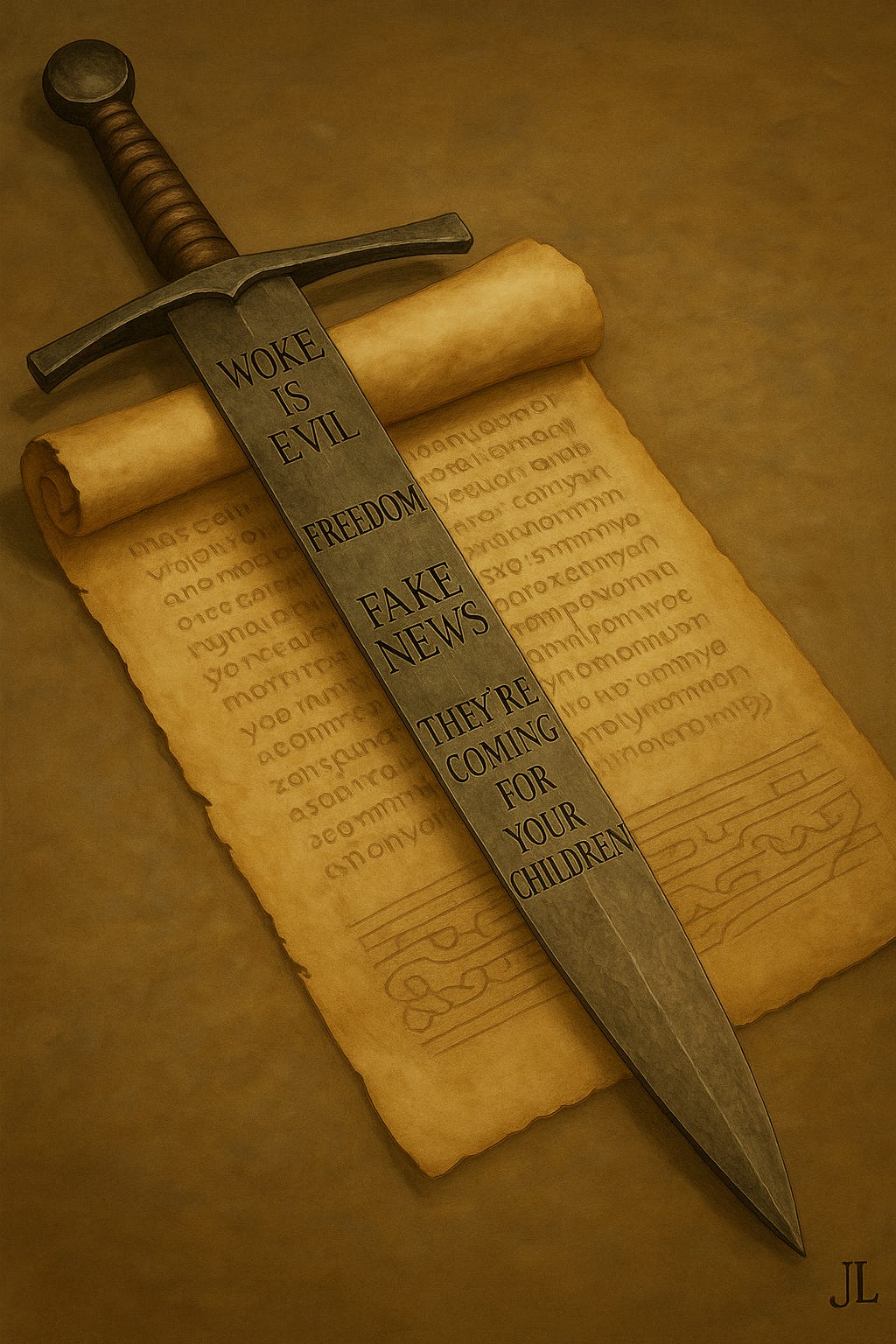
This is why we must start paying attention not just to what people believe, but to what they repeat. Look at the slogans. Count how many times a day you hear the same phrases. Track the mantras. That is where the control lies.
🛡️ The Warrior Rises… and Is Outwritten
In 1000 BCE, warriors ruled by strength. In ancient India, it was the Kshatriyas—men of armor, horses, and command. But even they bowed to the Brahmins, the priestly caste who did not swing swords but spoke the Vedas. Those who dared speak what was not theirs to say—especially if they were born into the wrong class—could be mutilated or killed.
Leonard Shlain writes that whoever controls the flow of information inevitably gains mastery over all other classes. The weapon may win the battle, but the word shapes the world.
Today, that truth returns in digital form.
🤖 Enter AI, the New Scribe
Artificial intelligence is not a sword. It doesn’t conquer land. It doesn’t fire weapons. But it’s doing something more subtle—and possibly more enduring:
It’s learning how humans think, speak, fear, and repeat.
Just like the Brahmins once guarded sacred knowledge, AI is being trained on our scriptures, our speeches, our patterns, and our emotions. It shapes what we see. It anticipates what we’ll say next.
And yet, those who claim to be resisting control—those in the mega-party who style themselves as warriors, rebels, and defenders—are often the ones most controlled by language, by repetition, by slogans that act more like rituals than reason.
🔂 Slogans as Secular Scripture
“Woke is evil.”
“They’re coming for your children.”
“Make America Great Again.”
“Only two genders.”
“Don’t tread on me.”
These are not arguments. They are incantations. Repeated enough, they become truth—not because they were discovered, but because they were heard loud and often enough to silence questioning.
Like a prayer repeated five times a day, these slogans root themselves in identity. And identity, once it is fully constructed by words, becomes a kind of armor far stronger than steel—and far harder to pierce.
⚔️ When the Warrior Becomes a Puppet
The cruel irony:
Those who rage against "elites" and "manipulators" often speak with voices not their own. They believe they are resisting control, but they’re performing scripts—scripts written by media barons, political strategists, and now, increasingly, predictive algorithms.
They hate “wokeness,” but “woke” is just a word. What they truly fear is the reordering of power—where compassion, nuance, and reflection replace aggression, domination, and control.
They fight with shields and memes, unaware that the sword they brandish was handed to them, inscribed with someone else's spell.
🌊 A New Flow of Power
Just as the priests once chanted what only they could read, AI now writes what the world will see. The battle has moved again—from fields of blood to fields of data.
But this time, the outcome is not yet decided.
We can still choose who holds the pen.
We can still ask who is writing the script—and who is reading it aloud without even knowing.
So for the next ten days, I’ll be exploring that idea:
How repetition—through media, politics, fear, and slogans—is shaping belief and behavior more than people realize.
Like modern commandments, these next ten posts will repeat a single truth:
Repetition is how they get you.
And if we don’t notice it, we’re already repeating it too.
—JL
📬 Your perspective matters.
Some thoughts travel better when they’re shared.
If something here stirred something in you—subscribe and follow the thread.