

Yesterday, I wrote about something I encountered while trying to access ordinary information on the IRS website.
Displayed alongside tax records, payment information, and other taxpayer services was a prominent advertisement for Trump Accounts—a taxpayer-funded children’s savings program carrying the sitting president’s personal name.
After I published the post, a reader left this comment:
“Now go look at who is admin for that Trump website and follow the story from there. It’s disturbing.”
The word admin could have meant several things.
Who administers the financial program?
Who administers the government website?
Who designed the website and decided how the program would be presented to the public?
I began following those different trails.
Four paths from the U.S. Capitol, Treasury, an IRS tax form and a government design desk converge at a leafy tree marked “Trump Accounts,” with dark, damaged roots exposed below.
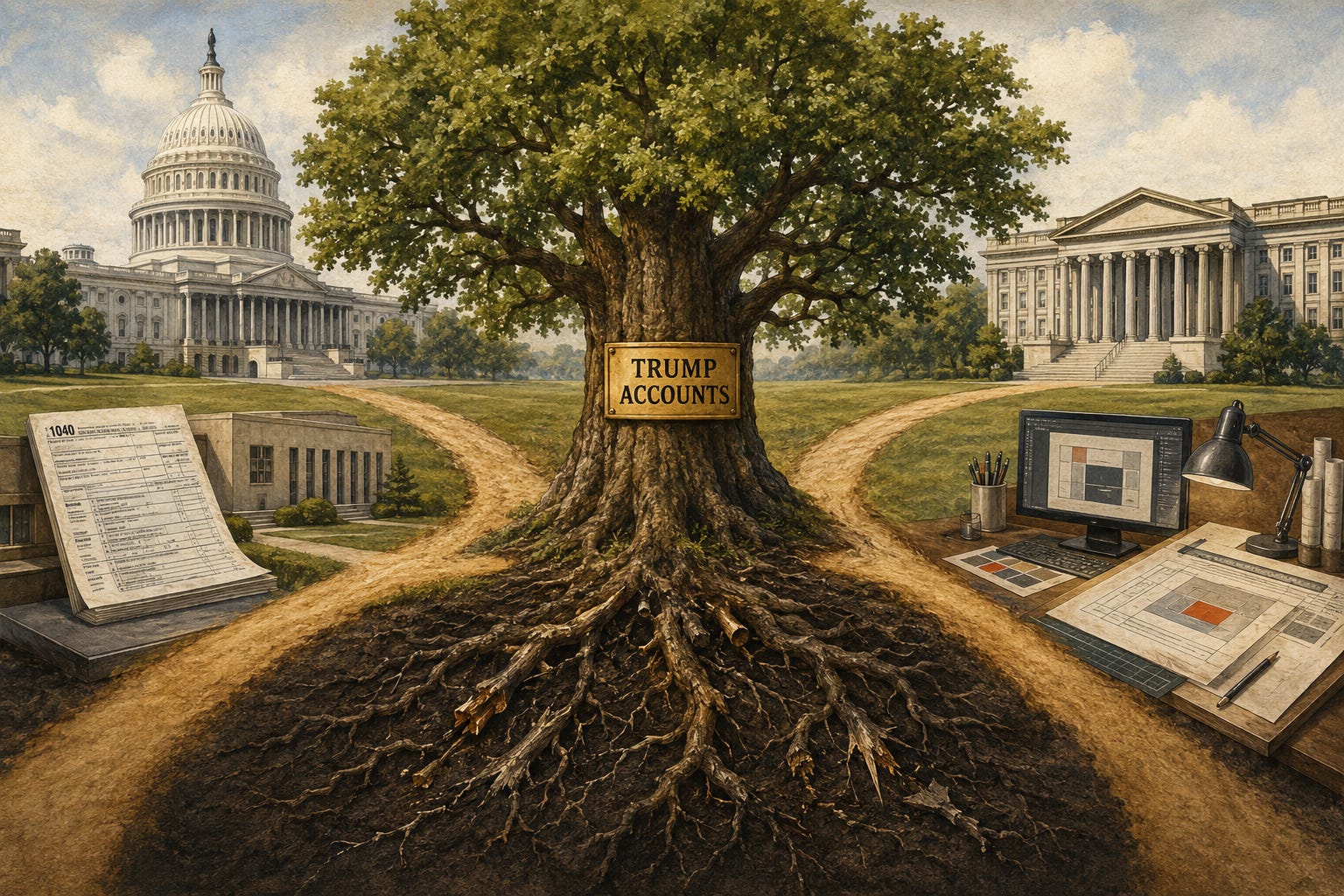
They do not all describe the same government function. Congress created the program and placed the name “Trump accounts” into the tax code. The IRS handles enrollment through Form 4547. The Treasury Department oversees the initial accounts and says it retains control over the application and its operations. BNY serves as a financial agent, while Robinhood serves as the initial trustee and brokerage provider.
But then there is the public-facing website—the part that determines what citizens see, what words they encounter, and what associations form before they have examined any of those administrative details.
At the bottom of TrumpAccounts.gov is a credit:
“Designed in DC by National Design Studio.”
I had never heard of the National Design Studio.
It sounds like an independent design firm or perhaps a longstanding government agency.
It is neither.
President Donald Trump created the National Design Studio by executive order on August 21, 2025. It was placed inside the White House Office of the Executive Office of the President. Its administrator reports to the Office of the White House chief of staff.
The executive order describes its mission as improving the appearance and usability of federal services. Government websites are often outdated, confusing, and unnecessarily difficult to navigate, so that purpose could certainly serve the public.
Making government easier to use is a worthwhile goal.
But design is not limited to making buttons easier to find.
Design also determines what receives emphasis. It decides what words are repeated, whose image appears, who receives credit, and how people understand the relationship between a service and the institution providing it.
The National Design Studio says it is changing how Americans “experience their government.” Its website lists its featured projects. Among them are:
Trump Accounts.
TrumpRx.
These are not campaign websites. They are government projects carrying the personal name of the sitting president, designed through an office he created inside the White House.
That is where the trails begin to converge.
One trail begins with Congress placing Trump’s name into the tax code.
Another runs through the IRS, where the program appears alongside the ordinary information taxpayers must access.
Another runs through the Treasury Department, which oversees the program and retains control of its application and operations.
And the public-branding trail leads directly to a design office created inside the Trump White House.
Each institution performs a different function. That distinction matters, and I do not want to erase it merely to make the story sound simpler.
But the cumulative effect also matters.
At every stage, the citizen encounters the same name:
Trump.
The name of the president becomes the name of the public benefit. The name of the public benefit becomes a government web address. The web address leads to a website designed by a White House office. The website presents money from the U.S. Treasury through a program branded around the individual occupying the presidency.
The federal government and the president begin to feel less like separate things.
That is the disturbing point where the trails converge.
We do not need access to anyone’s private thoughts to establish that this branding is intentional. The National Design Studio employs professional designers, engineers, writers, and branding specialists. Its purpose is to shape how Americans experience public services.
The choices may be defended as effective communication. They may be described as celebrating a president’s policy achievement. But they are still choices—and they confer a clear political benefit.
A taxpayer-funded benefit is repeatedly associated with one political leader’s personal identity.
This is different from accurately saying:
“President Trump signed the legislation that created this program.”
That describes his governmental role.
Naming the program, the form, the website, and the public experience after him does something more. It incorporates the president’s personal brand into the machinery of government.
Another reader responded to yesterday’s post by mentioning our three branches of government and the checks and balances that are supposed to prevent abuses of power.
That raises the next difficult question.
Checks and balances do not function automatically merely because they are written into our constitutional structure. They depend on officials within each branch being willing to preserve the distinction between loyalty to a person and responsibility to a public institution.
Following the trails tells us where these decisions lead.
The image of a tree helps us see what their convergence may do to the larger structure.
The Constitution is often represented as a tree with three branches. But a tree is not necessarily healthy simply because all three branches remain visible and their leaves remain green.
Roots can be cut, compressed, or redirected. Water can be forced into channels that serve a structure imposed around the tree rather than the living system beneath it. Rot can begin where the branches join the trunk, long before the damage becomes visible in the leaves.
Our government can weaken in much the same way.
Congress, the executive, and the courts can all retain their names and outward forms. But their protective function depends upon the people inside them remaining willing to exercise independent judgment.
We cannot honestly claim that every official in every branch is controlled by one person. But we can recognize particular moments when branches are reinforcing presidential power rather than checking it.
In this case, Congress placed the president’s name into the law. The executive branch administers the resulting program. A design office inside the White House then built the public experience around that personal brand.
The branches remain visible.
The question is what is happening where they join the trunk.
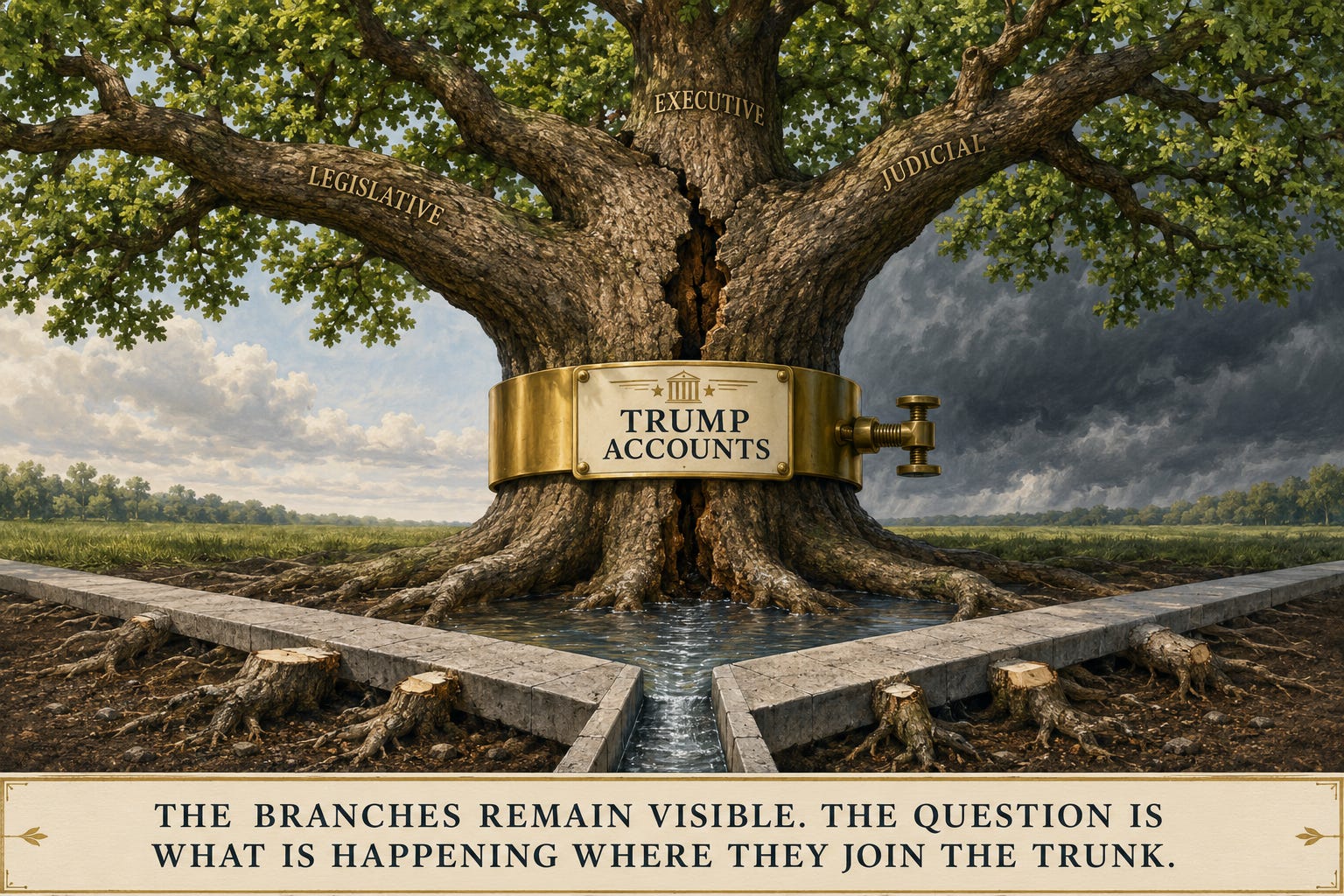
The three green branches represent the legislative, executive, and judicial branches of government—still recognizable and outwardly alive. The Trump Accounts plate and tightening gold band represent a personal political brand being fastened around their shared governmental structure. The cut roots, concrete channels, pooled water, and beginning decay represent institutional independence being redirected or weakened before the damage necessarily appears in the leaves.
This does not prove that every person involved shares the same motive. It does not, by itself, establish that a law was broken.
But it does show how institutional boundaries can become blurred without being formally erased.
The public does not wake up one morning to discover that the government and its leader have suddenly become indistinguishable.
It happens through accumulation.
A name.
A logo.
A web address.
A photograph.
A repeated phrase.
A public benefit presented through a personal brand.
Each decision can be defended separately. The larger pattern becomes visible only when we follow the trails—and then step back far enough to see what they are doing to the tree.
When several trails lead toward the same concentration of identity and power, we should not look away simply because each individual step was professionally designed.
The branches may remain visible.
The leaves may still be green.
We should still pay attention to what is happening where they join the trunk.
Sources: Executive Order establishing the National Design Studio · National Design Studio project list · Treasury’s explanation of the program’s administration and design · Current TrumpAccounts.gov website · IRS Trump Accounts page
—JL
Where this trail began: This post continues the conversation started in [When Public Money Becomes Presidential Branding — A Presence of Mind, Day 70]. Read the original observation and the reader comments that led to this next step in the investigation.