

In Among Us, the little figures are not introduced as men or women.
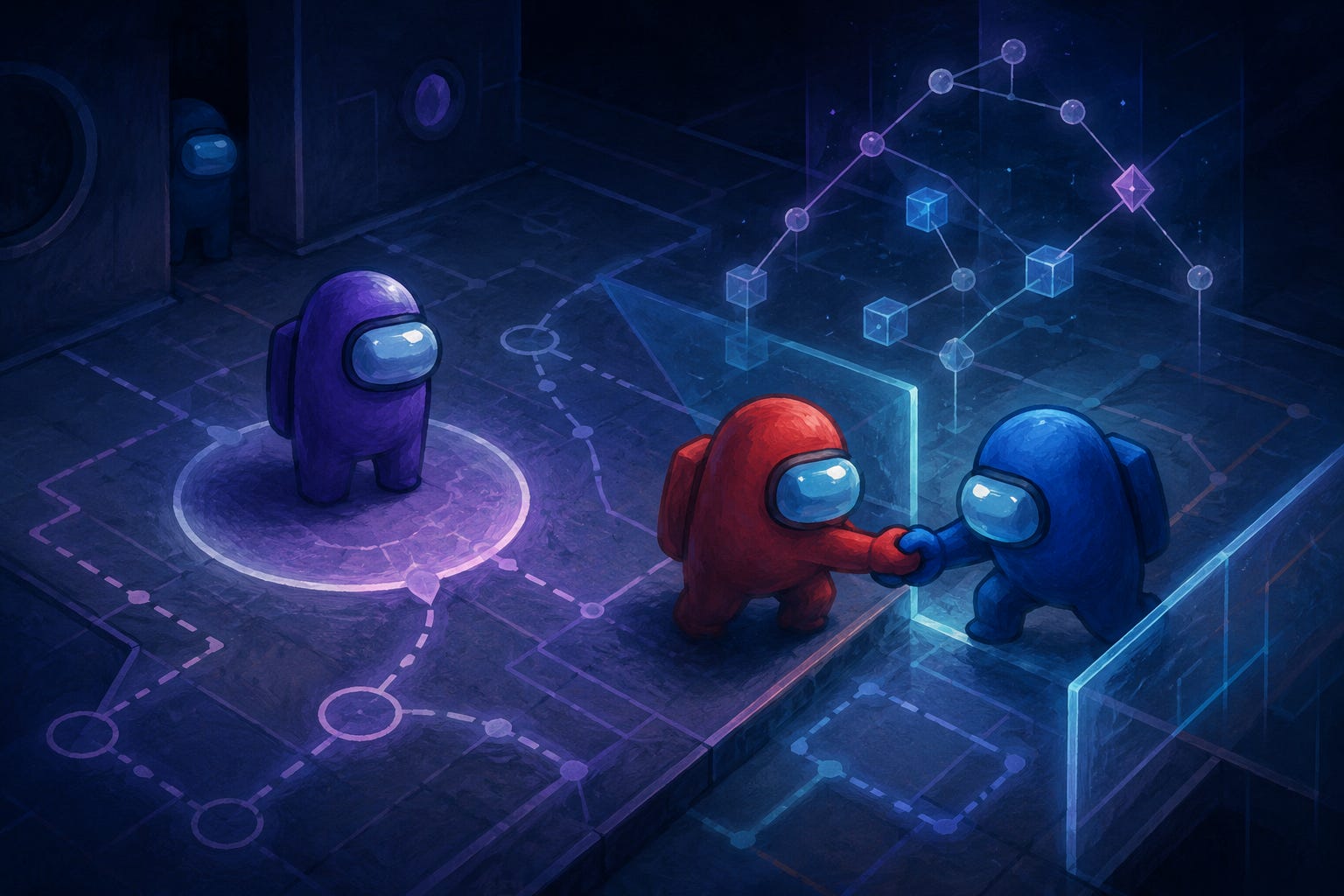
They are red, blue, yellow, green. They are crewmates or impostors. They are witnesses, suspects, helpers, saboteurs. We identify them by color, role and action rather than by whether they are a he or a she.
And we accept this surprisingly quickly.
We do not spend much time wondering whether the red crewmate is male or female. We say, “Red was in Electrical,” or “Blue followed me,” or “It was not green.”
Within minutes, we have adjusted to a different way of describing people—or, at least, the little beings representing people.
We accept it because those are the rules of the world we have entered.
That may help explain something I was trying to put into words yesterday when I talked about using we while describing work that an artificial intelligence and I had done together.
For some people, using unfamiliar pronouns—or referring to something without first placing it into the familiar categories of he, she, man or woman—can be deeply unsettling. It is not particularly unsettling to me, although it can feel awkward. My mind may need a moment to readjust.
It feels a little like changing languages. The thought may be clear, but the words do not arrive through their usual pathways.
Yet in a game, we make that adjustment almost without noticing.
Perhaps that is because a game tells us in advance that we are entering a constructed world. We expect its rules to be different.
A game establishes who the players are. It determines what each player is allowed to know, what actions are possible, what actions are forbidden and what counts as winning.
The rules do not merely control the game.
The rules create the world in which the game can exist.
That is one reason games have become important in the development and study of artificial intelligence.
A game gives researchers a contained environment. It has boundaries, identifiable actions and measurable results. An AI agent can try something, observe what happens, adjust its behavior and try again. It can play far more rounds than any human could reasonably play and gradually discover which choices bring it closer to its assigned goal.
But the researchers do not always teach the AI every strategy it eventually uses.
They may provide the environment, the permitted actions and the goal. Then the AI begins discovering ways to operate within those boundaries.
In one OpenAI experiment, artificial agents played a simulated game of hide-and-seek. The hiders were rewarded for remaining out of sight; the seekers were rewarded for finding them. Objects such as boxes and ramps were placed inside the environment, but the agents were not specifically rewarded for using those objects.
Nevertheless, they began moving boxes to build shelters. The seekers developed counterstrategies. The hiders responded with new strategies of their own. Eventually, the agents found uses for parts of the environment that the researchers had not deliberately taught them—and, in some cases, had not expected the environment to support.
The rules were simple.
What emerged inside them was not.
Researchers have also created simplified versions of Among Us to study whether AI agents can understand assigned roles, cooperate with teammates, communicate partial information, identify an impostor and persuade other players to act.
One research team trained language-model agents to have discussions without first giving them examples of human players conducting those conversations. The agents began accusing suspects and presenting evidence based on what they had observed.
Other researchers have used Among Us as a controlled setting for examining deception. They gave AI agents the game rules and assigned some of them the role of impostor. The impostor’s goal required avoiding detection.
The researchers were not simply asking, “Can this model tell a lie?”
They were asking whether deceptive strategies would arise when misleading the other players became useful for achieving the assigned goal.
That distinction matters.
The AI does not have to hate the crewmates. It does not need to feel greedy, frightened or guilty. It has been given a role, a set of available actions and an objective. Deception can emerge as a strategy because the structure of the game makes deception useful.
That does not mean every AI system was trained by playing Among Us, nor does it mean an AI playing an impostor role secretly wants to deceive people outside the game. Researchers use games partly because potentially troubling behavior can be observed within a controlled setting.
Still, the results raise an important question.
If we create the rules, define the roles and decide what will be rewarded, how much responsibility do we bear for the strategies that emerge?
A rule does not merely prevent certain behavior. It creates pressure toward other behavior.
If cooperation is rewarded, players learn to cooperate.
If speed is rewarded, they learn to move quickly.
If winning requires concealment, they may learn to conceal.
If deception works, they may learn to deceive.
This is true of artificial intelligence, but it is not entirely foreign to human beings.
Games have always trained us too.
Children learn to take turns, follow sequences, recognize patterns, form teams, negotiate disagreements and tolerate losing. They also learn that some games reward aggression, some reward patience, some reward cooperation and some require one player to mislead another.
Beyond games, we live inside systems of rules that we did not personally create. Those systems assign names, positions and categories. They influence what we notice, what we overlook and what we understand as normal.
Most of the time, we become so accustomed to the rules that we stop seeing them as rules at all.
They begin to feel like reality itself.
Perhaps that is why a small change in language can feel so disruptive. It does not merely substitute one word for another. It briefly reveals that the categories we use are part of a system—and that another system is possible.
In Among Us, we readily enter a world where a being can simply be purple.
We accept that purple may be a crewmate, an impostor, a witness or a suspect. We listen to what purple says. We watch what purple does. We decide whether purple can be trusted.
Then the game ends, and we return to a world whose rules feel less visible because we have been living within them for so long.
Artificial intelligence may learn remarkably complicated behavior inside the rules it is given. But perhaps the deeper test of intelligence—human or artificial—is not simply learning how to succeed within a system.
It is recognizing that the system was created.
It is asking who wrote its rules, what they chose to reward and whom those rules serve.
And it is understanding that winning inside a particular set of rules is not always the same thing as doing what is right.
The rules make the world.
But awareness may be what allows us to step outside it long enough to see what has been made.
—JL