

I was standing in line at a Salvation Army thrift store, and for some reason everything felt louder than it actually was.
People were trying on clothes. Holding shirts up to themselves. Looking in mirrors. Turning slightly to see how something fit. A woman in front of me had put on a little vest and turned around, almost asking without asking, What do you think?
It was such a normal human moment.
And yet it felt surreal.
Because all at once I could see how much of life is spent asking some version of that same question:
How do I look in this?
Do I belong in this?
Is this me?
Is this what I am supposed to wear?
We think of clothing as personal choice, and sometimes it is. But clothing is also signal. It tells the world something before we speak.
It can signal class. Modesty. Rebellion. Religion. Gender. Culture. Wealth. Belonging. Safety. Obedience.
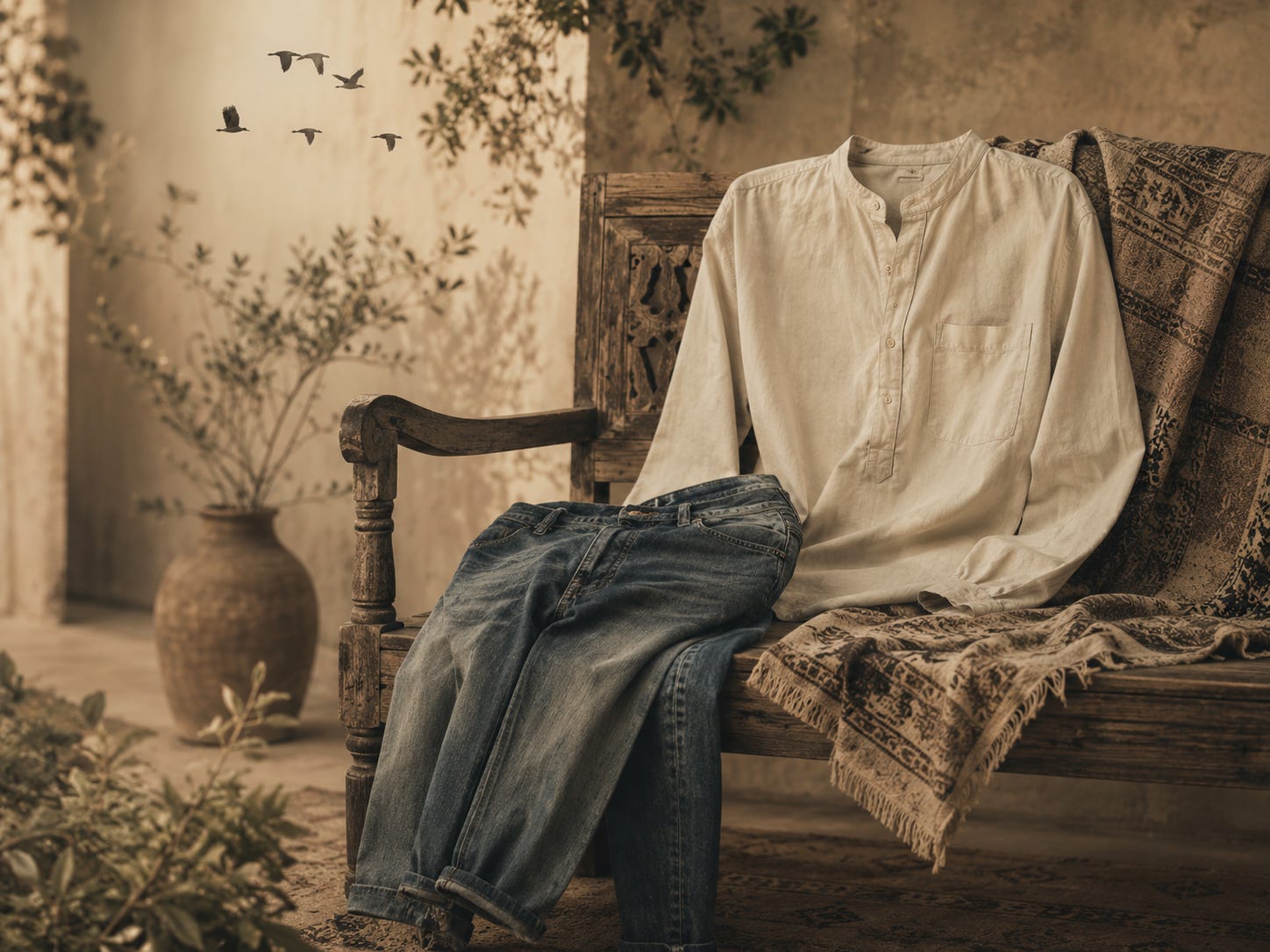
Even the way I dress is a kind of signal, though I have usually thought of it as the opposite. I wear blue jeans every day. I wear the same kind of comfortable shoes with no designs, no frills, and when I find a cheap pair that works, I buy two or three because I know they may not be there later and it eliminates the decision to hunt down a new pair. Outdoors I still prefer bare feet so that I can feel the ground. I wear loose shirts, white or off-white partly because I work in paint and small stains can usually be dealt with using the same paint. It keeps a good shirt from feeling ruined too quickly. But it’s more than practical. It eliminates a daily decision. Less clothing decisions… less mental clutter. A little more space for my brain to rest.
Maybe it’s the simplicity. Maybe it’s the modesty. Maybe it’s the quietness of it. Maybe somewhere in my mind it connects to monks, or Eastern philosophy, or the image of people dressed in a way that seemed composed and not asking to be looked at.
But I was not always this way.
When I was young, I wore cutoff shorts and T-shirts. I was often barefoot. I dressed for heat, movement, comfort, and freedom. I wasn’t trying to look like anything. I wasn’t trying to invite attention. I was just trying to be outside, to be comfortable, to move through the world and without the attention on me.
But the world does not always let girls belong to themselves.
At some point, I began to notice that my comfort was being read by other people as something else. Attention came that I didn’t ask for. Men looked too long. Older men mistook maturity for permission. What had felt like freedom started to feel invaded.
Later, life took me into other kinds of rooms, other kinds of work, other kinds of survival. There were years when clothing and appearance had a different purpose because money was needed and children had to be cared for. I don’t say that with shame. I say it because women’s lives are often more complicated than the simple stories people want to tell about them.
So maybe now I’ve gone in the other direction.
Not toward darkness. Not toward hiding. Not toward punishing myself for having a body. I still wear light clothes. I still wear blue jeans, because jeans have always felt like freedom to me — practical, ordinary, durable, unpretentious. I can sit on the floor. I can move. I can work. I can disappear a little without disappearing completely.
My clothes now are not a rejection of beauty. They are a refusal to be consumed by performance.
They are a quiet letter to my children, whether they know it or not:
Find what lets you move through the world with your mind intact.
Find what gives you freedom without asking you to become someone else.
Notice what you chose, and notice what was chosen for you.
That was why the thrift store line struck me so hard. I was watching people try things on, but I was also thinking about all the invisible things we are handed to wear: beliefs, roles, fears, loyalties, religions, politics, ideas about womanhood, ideas about obedience, ideas about what makes a person good.
Maybe I have been trying, in my own way, to step outside the performance.
But even that is still a kind of clothing.
A uniform of not wanting to perform is still a uniform.
That thought stayed with me as I stood there, and then I noticed the music playing overhead. Because it was the Salvation Army, the music had a religious tone. Soft enough to be background, but present enough to shape the air. Every so often I could hear the words: Jesus, Lord, praise, love.
For a person of sincere faith, that music might feel comforting. Familiar. Safe.
But I also thought about how powerful background messages can be.
Not just music in a store, but all the background messages we grow up inside.
The songs.
The sayings.
The family rules.
The church rules.
The political slogans.
The gender roles.
The idea of who should lead and who should submit.
The idea of who is respectable and who is dangerous.
The idea of who is competent and who is only there because someone “gave” them something.
That’s where culture becomes more than culture.
It becomes clothing for the mind.
And often we don’t choose it consciously. We inherit it. We are dressed in it long before we know how to ask whether it fits.
Religion can comfort people. It can create community. It can give language to grief, mercy, forgiveness, and hope.
But religion can also be used by power.
That distinction matters.
Sincere faith is not the same thing as religious control. A person can love God and still resist cruelty. A person can believe in Jesus and still question hierarchy. A person can have faith and still refuse to hand their conscience over to a leader, a pastor, a political party, or a man standing at the front of the room claiming authority.
The danger begins when belief is used to stop thought.
When obedience is mistaken for goodness.
When questioning is treated as rebellion.
When compassion is called weakness.
When the rules keep changing, but only in the direction of more control.
That is how a culture can slowly redress people.
Not all at once. Not dramatically. Not with a costume change everyone notices.
Just one layer at a time.
A phrase repeated enough times starts to sound like truth.
A leader excused enough times starts to seem untouchable.
A cruelty defended enough times starts to feel normal.
A contradiction ignored enough times stops feeling like a contradiction.
The same people who say they believe in merit can excuse incompetence when it comes from someone they have chosen to follow.
The same people who say children should not get rewards just for showing up can reward grown leaders simply for belonging to the right side.
The same people who complain that others are being hired for identity can overlook unqualified people when the identity being protected is power.
That is not morality.
That is loyalty dressed up as principle.
And maybe that is what felt so strange to me in that line at the Salvation Army.
I was watching people try on clothes, but I was thinking about all the invisible things people try on too.
A belief.
A role.
A political identity.
A religious certainty.
A version of womanhood.
A version of manhood.
A version of patriotism.
A version of goodness.
Some things we wear because they protect us.
Some things we wear because they help us move through the world.
Some things we wear because they are beautiful, meaningful, or chosen.
But some things were handed to us before we knew we had a choice.
And some things no longer fit.
The question is not whether appearance matters. It does. We are human. We read one another. We use clothing and symbols and sound to find our place.
The better question is:
What are we wearing that no longer belongs to us?
What belief did we inherit but never examine?
What fear are we still carrying because someone taught it to us young?
What obedience are we mistaking for morality?
What costume are we calling character?
What system dressed us before we were old enough to understand the room?
That day in the Salvation Army line, nobody was doing anything wrong. People were simply looking for clothes. They were holding things up to their bodies, turning slightly, asking silently whether something fit.
Maybe that is what we all need to do more often.
Not just with shirts and vests and shoes.
But with the beliefs we carry.
Hold them up to the light.
Turn them around.
Ask whether they still fit.
Ask whether they were ever truly ours.
Because people are always being dressed by culture — sometimes in fabric, sometimes in belief, sometimes in fear, sometimes in obedience.
And the danger comes when people stop asking whether the thing they are wearing still belongs to them.
__JL
Related reflections:
Day 64: From Following to Understanding — on the shift from inherited patterns to conscious seeing.
Day 65: Continuity — on staying connected to the thread of ourselves across time.
Day 67: Presence of Mind — The Scaffold We Build, One Board at a Time — on building the inner structure that helps us notice what we once accepted without question.