

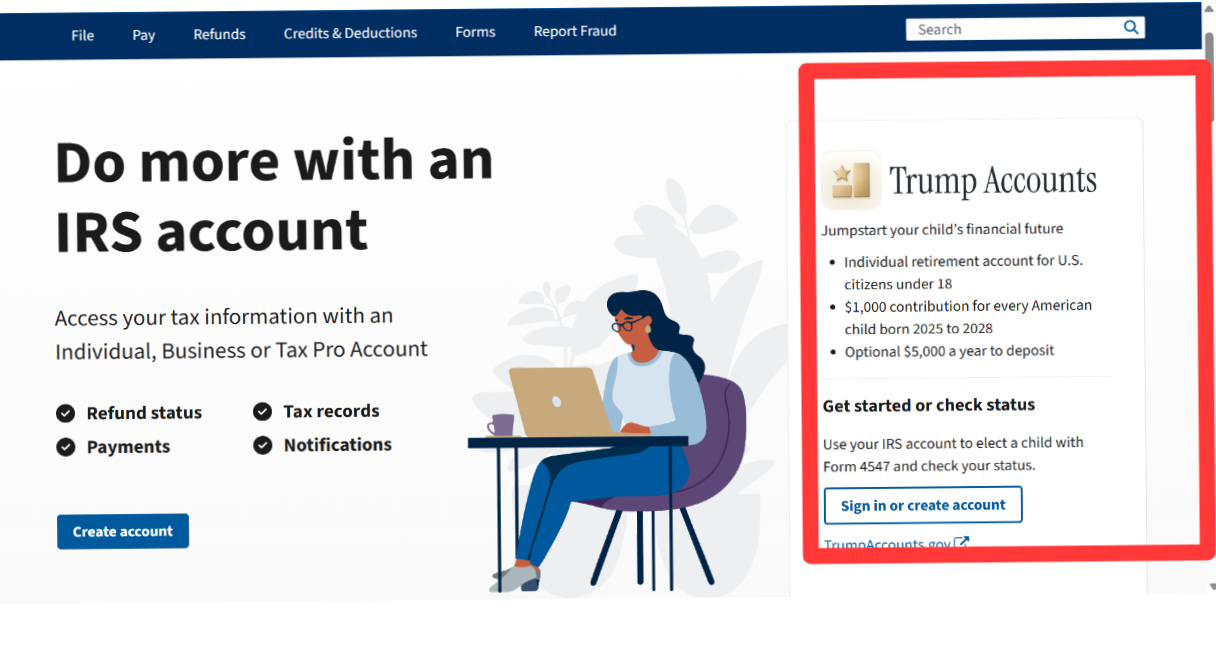
Today I went to the IRS website because I was trying to deal with my own taxes. On the homepage, I saw something I did not expect to see on a supposedly nonpartisan government website:
Trump Accounts.
Not “children’s savings accounts.”
Not “Section 530A accounts.”
Not even “Treasury children’s investment accounts.”
Trump Accounts.
The IRS advertisement directed people to a separate government website: TrumpAccounts.gov.
At first, I wondered how a federal agency responsible for administering our tax laws impartially could be used to promote a government program under the sitting president’s personal name.
Then I learned that Congress itself placed the name “Trump accounts” into Section 530A of the Internal Revenue Code. That may make the use of the name legally defensible. The IRS can say it is simply administering a program under the name Congress gave it.
But then I discovered something more troubling.
An earlier promotional description associated with TrumpAccounts.gov stated:
“Trump Accounts provide eligible American children with tax-advantaged investment accounts courtesy of President Donald J. Trump.”
The same wording was also circulated by official government social-media accounts, including the United States Department of Education.
Courtesy of President Donald J. Trump?
No.
The $1,000 placed into these accounts does not come from Donald Trump’s personal bank account. It is not a personal gift from him. It is federal money authorized through legislation passed by Congress.
In other words, it comes from the United States Treasury—and ultimately from the American public.
The earlier wording was deceptive in its effect because it encouraged people to associate a taxpayer-funded benefit personally with Donald Trump. It made government money sound like presidential generosity.
The current TrumpAccounts.gov website no longer uses the phrase “courtesy of President Donald J. Trump.” It now says:
“With $1,000 from the U.S. Treasury, your child has a huge head start on the American dream.”
That wording is more accurate.
We can establish that the language changed. What we cannot establish from the public information presently available is why it changed. Perhaps officials recognized that “courtesy of President Donald J. Trump” was misleading or politically problematic. Perhaps the website was simply redesigned for the program’s full launch. Without internal records or an official explanation, we should not claim to know their motive.
But the change itself matters.
First, the public was shown language crediting Trump personally.
Later, that language was replaced with wording identifying the actual source: the U.S. Treasury.
This is the kind of thing I want to begin noticing more carefully—not only outright falsehoods, but the slow twisting of language.
A government does not always have to tell people, “The president personally gave you this money.” It can create that impression more subtly:
Put his name on the benefit.
Repeat his name on the IRS homepage.
Create a government domain bearing his name.
Describe taxpayer-funded money as being “courtesy of” him.
Place his photograph and personal quotation prominently on the official website.
Each choice reinforces the same message: This came from him.
But it did not come from him.
A president can support legislation. A president can sign legislation. A president can advocate for a program and take political credit for helping enact it.
But a president should not be presented as the personal provider of money belonging to the American people.
There is an important difference between saying:
“President Trump signed the law that created these accounts.”
and saying:
“These accounts are courtesy of President Trump.”
The first describes a governmental action. The second transforms public money into a personal favor.
That distinction may seem small. It is not.
Language shapes how people understand power. When taxpayer-funded programs are branded as gifts from an individual leader, citizens may gradually stop seeing the government as an institution that belongs to them. Instead, they may begin seeing public benefits as favors bestowed by the person in charge.
That is why I am paying attention.
Not because every use of a president’s name is automatically illegal. Not because noticing propaganda requires exaggerating what the evidence proves.
I am paying attention because words matter—and because government money is not the president’s money.
It is ours.
Sources: Current TrumpAccounts.gov website; Internal Revenue Code §530A; dated preservation of the earlier TrumpAccounts.gov description.
—JL
Now go look at who is admin for that trump website, and follow the story from there. It's disturbing.