

A Presence of Mind—Day 62
There’s a moment in any system
when things start to move faster than people can follow.
It doesn’t look like failure.
It looks like progress.
Movement.
Momentum.
Acceleration.
When speed outruns understanding,
the structure doesn’t fail immediately.It weakens first.
People can be holding the same structure…and feel completely different levels of weight.
Nobody thinks they’re lying.
They’re reacting to where they’re standing under the structure.
© JL. All rights reserved. No reproduction without permission
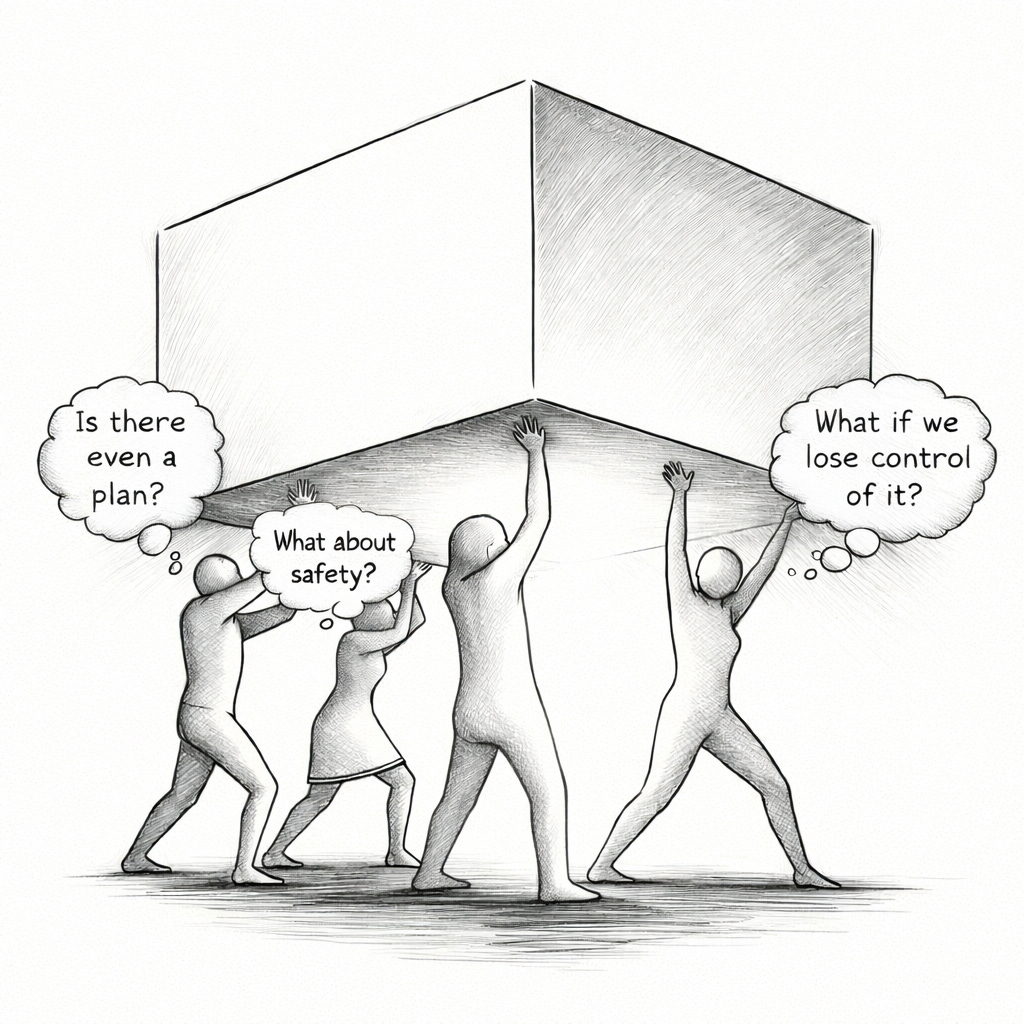
That’s the part that’s easy to miss.
Because from the outside, everything still appears to be working.
In fact, it can look like it’s working better than ever.
Faster results.
Quicker answers.
More output.
And that’s where the tension begins.
Not because something is breaking…
but because something is being pushed beyond what it can sustain.
We’re seeing that now in the systems we’re building.
Artificial intelligence is moving quickly.
Faster than most people can fully understand.
Some are excited by it.
Some are uneasy.
Some are trying to keep up.
But underneath that speed,
the same principles still apply.
Clarity matters.
Balance matters.
Understanding matters.
We have a tendency to compress time.
To take processes that unfold over years, generations, or longer…
and reduce them into something quicker, simpler, easier to understand.
But the systems we depend on don’t actually work that way.
Soil takes time.
Ecosystems take time.
Understanding takes time.
Even the way we explain where we come from often shortens what was a long, layered process into something much smaller and more immediate.
And when we start to believe those compressed versions…
we begin to think we can speed everything up without consequence.
But time isn’t just a backdrop.
It’s part of the structure.
And when we try to remove it—
to accelerate beyond what systems can absorb—
we don’t eliminate the process.
We disrupt it.

And strangely, the same system that’s accelerating everything…
is also asking us to slow down.
To think more clearly.
To choose our words more carefully.
To be precise about what we mean.
It’s exciting.
But it also asks for restraint.
Restraint isn’t the opposite of progress.
It’s part of what makes progress sustainable.
Without it, systems don’t stabilize.
They stretch.
They strain.
They begin to lose the quiet supports that were holding them together.
You don’t see it right away.
But you feel it.
In the uncertainty.
In the questions.
In the sense that things are moving faster than they’re being understood.
And that’s where the real work is.
Not in stopping progress.
But in learning how to move with it
without breaking the structure that supports it.
__JL