

A Presence of Mind—Day 59
Years ago, my oldest daughter, and I walked into the Contemporary Arts Museum here in Houston. Just inside the entrance, across from the doors, was a giant chalkboard covering nearly an entire wall.
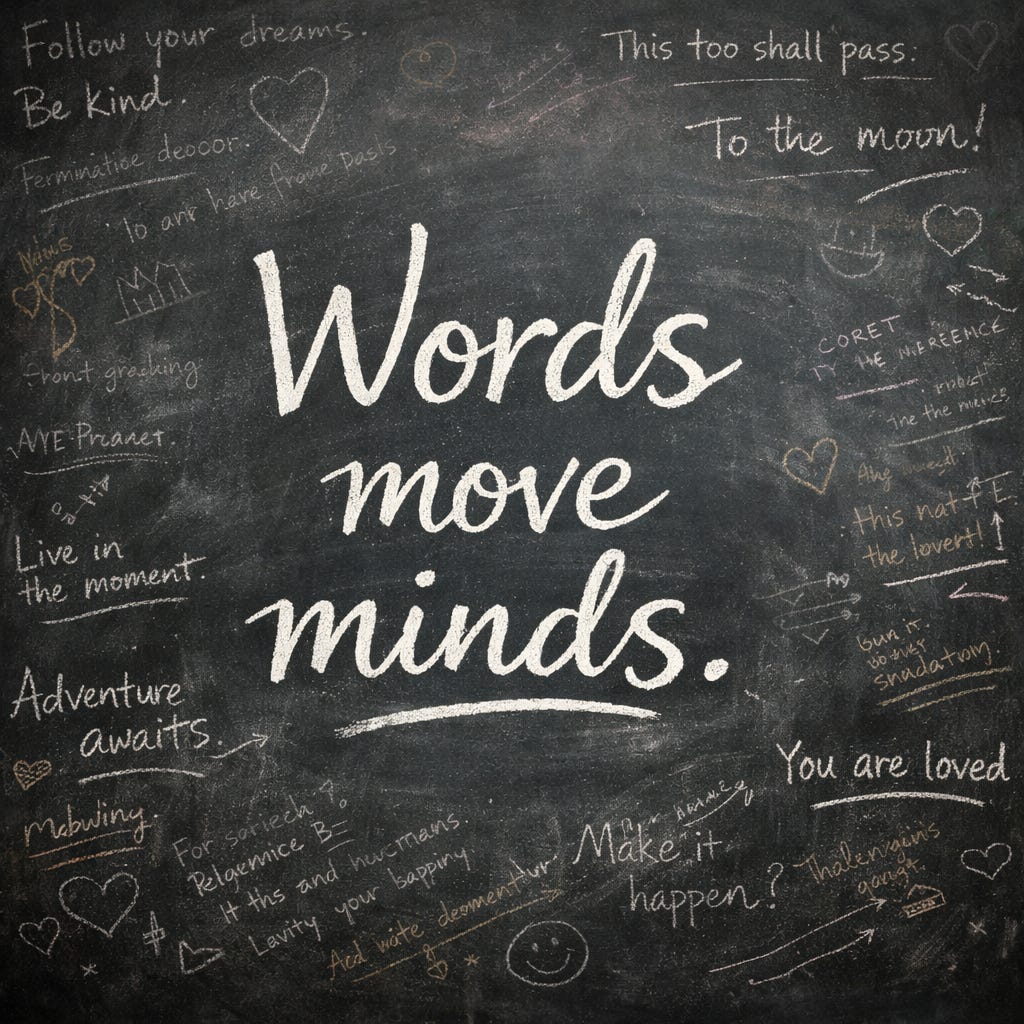
It wasn’t graffiti. It was something different.
Visitors had been invited to leave a thought behind. The board was filled with phrases, fragments, and ideas—little traces of the minds that had passed through the museum that day. Some were playful, some reflective, some curious. Nothing crude or hateful. It felt more like a wall of wandering thoughts than anything else.
Daughter stood there reading for a moment and then turned to me.
“What should we write?”
I’ve always been someone who flips through books looking for a line that stands out—something that catches my attention and stays with me. Somewhere along the way I must have come across these words, because they came to mind in that moment as if they had been waiting there.
I said, “Write this.”
Words move minds.
So she picked up the chalk and wrote it on the board.
I don’t know if I ever took a picture of it. I might have. I’ve been thinking about going back through my photos to see if I captured that moment. But even if I didn’t, the memory stayed with me.
At the time, it just felt like one thought among many on a wall of passing ideas.
I didn’t realize then how true those words would turn out to be.
Years later, those words came back to me in an unexpected way.
This same daughter recently sent me a song called Letters From the Sky and asked me to listen closely to the lyrics. Music, for her, is a language for feelings she struggles to explain in ordinary conversation.
The song is beautiful, but it lives in a particular emotional space. It speaks about regret, unfinished conversations, and the longing to say things that were never spoken while there was still time. The voice in the song imagines messages coming from the sky—letters filled with everything that might have been said if life had unfolded differently.
Listening to it felt a little like being invited to step into a certain kind of house.
Some houses are places of rest. Others are places where sorrow has been carefully preserved, room by room, so that the past never quite loosens its grip.
Songs, stories, and even the words we repeat to ourselves can build those houses in the mind. They shape the emotional worlds we live inside. Sometimes they help us understand our past. Other times they quietly invite us to keep living inside it.
That realization brought me back to the people who shaped my own relationship with memory.
The longer I live, the more I see how true those four words really are.
Words don’t just communicate ideas. They shape the landscapes we live inside.
The books we read, the stories we repeat, the songs we return to—these things create emotional terrain. Some landscapes invite us to walk forward. Others lead us back again and again to the same place.
Growing up, I lived inside a landscape shaped largely by my mother’s memories.
She was deeply interested in family history, but the way she carried it often felt heavy. Much of what she wrote in her diaries focused on the tragedies she had experienced. Reading those pages felt less like learning history and more like stepping into a room where sorrow had been carefully preserved.
It was difficult to see her past without also seeing her as a tragic figure moving through the present.
My grandmother, however, was different.
She carried the same family history—the same losses, the same stories—but she seemed able to hold it without letting it define the emotional atmosphere around her. She was strong, practical, and steady. She took care of details, saved money carefully, and kept life moving forward.
There were tragedies in her history as well. A sister, who had been placed in an asylum at the age of 7 or so, simply because she was deaf. A baby brother who lived less than a year before disappearing from the family story except for a small letter written by a tiny little girl, (my grandmother) that still survives though little Walter disappeared. There were photographs she once tried to throw away—images my mother managed to rescue.
History was present, but it did not become a house where everyone had to live inside the sorrow.
My brother , who spent more time around our grandmother growing up, seemed to absorb that perspective. He developed a strong interest in history itself—the context, the facts, the way events fit into the wider world. But he had little patience for conversations that tried to turn history into endless emotional introspection.
In many ways, I find myself standing somewhere between those two ways of remembering.
I understand the importance of knowing where we come from. But I also know how easily memory can turn into a place where we remain too long.
Lately I’ve been thinking about emotional landscapes in a more literal way—how the paths people walk through in their lives might be represented as physical landscapes. Our inner worlds are not static. They are paths we walk.
And the words we use—whether spoken, written, or sung—help shape the direction of those paths.
Some words open doors. Others close them. Some invite us to step forward. Others encourage us to sit down and stay in the past.
The best we can do is choose our words carefully.
Because the words we leave behind—on chalkboards, in songs, in stories—do more than express what we feel. They help build the emotional landscapes that others may someday walk through.
And if we are thoughtful, the people who come after us may see those doors standing open and decide to walk through them too.
__JL